
What Does Curated Itinerary Mean for Your Next Trip?
- The Italian on Waiheke - Tours & Transfers

- 3 days ago
- 7 min read

A curated itinerary is a travel plan built and vetted by a real person around your specific tastes, pace, and interests, rather than assembled from a generic template. Where a standard itinerary lists sights in order, a curated itinerary reflects first-hand local knowledge and deliberate sequencing. Industry writing increasingly treats the term as a specific promise, not a marketing flourish, according to travel curation terminology guidance. Small operators like Theitalianonwaiheke build their entire model around that promise.
Key Takeaways
A curated itinerary means a personally vetted, custom-built travel plan shaped around your preferences, not a mass-produced schedule sold to every traveler.
Point | Details |
Definition | A curated itinerary is built around one traveler’s preferences and pace, unlike a fixed, pre-packaged plan. |
Vetting matters most | First-hand checks of vineyards, guides, and restaurants separate curated plans from generic listings. |
Expect full transparency | Clear inclusions, exclusions, and third-party terms should be spelled out before you book. |
Lead time affects quality | Bespoke plans need 30 to 90 days to allow proper research and reservations. |
Personalization runs deep | Pace, dietary needs, and access requests can reshape every part of the day. |
Table of Contents
What Makes a Curated Itinerary Different From a Standard One?
The biggest difference comes down to two things: personalization and first-hand vetting. A standard itinerary gets written once and sold to thousands of people. A curated one gets shaped around the traveler in front of the curator, checked in person rather than pulled from a brochure.
Personalization level: built around your goals, dietary needs, and interests, not a generic traveler profile.
Local vetting: the curator has actually visited the vineyard, restaurant, or guide, not just read reviews.
Flexibility: the plan bends around weather, mood, or a missed flight instead of locking you into fixed slots.
Pacing and sequencing: downtime and travel time are planned deliberately, not squeezed between attractions.
Access: private tastings, closed-door dinners, or after-hours visits that don’t appear on a public booking page.
Transparency of inclusions: you know exactly what’s covered, what’s optional, and what a third party administers.
A wine tasting on a packaged tour might mean a bus stop at a large commercial cellar door. On a curated plan, it might mean a small boutique vineyard visit timed around the owner’s own schedule.
What’s Typically Included in a Curated Itinerary?
A well-built plan usually bundles several layers into one seamless day-by-day structure, according to one traveler-focused breakdown of custom itineraries. Expect these components:
Accommodations matched to comfort level and location preference, not just star rating.
Curated dining, often including reservations that would be hard to secure independently.
Vetted activities and guides who have been personally checked, not sourced from a directory.
Transport logistics, including transfers timed to avoid dead hours.
Pacing and built-in downtime, so the day doesn’t feel like a checklist.
Contingency planning for weather, closures, or a flight delay.
Ticketing and reservations handled ahead of arrival.
Local context and storytelling woven through each stop.
Gray areas exist, too. Delta Vacations notes that some activities inside a curated package are administered by third parties and governed by separate terms, so cancellations or changes aren’t always the curator’s call. Good providers personalize each layer: swapping a wine-heavy afternoon for a hike, adjusting a menu for allergies, or building a wheelchair-accessible route.
Why Do Travelers Choose a Curated Itinerary Over DIY Planning?
The value shows up in time saved and in the quality of what you actually experience. A curated plan trades hours of research for a shorter list of vetted, high-quality choices.
Time saved: hours of research get replaced by a short list of vetted options.
Deeper cultural access: local relationships open doors a search engine can’t find.
Smoother logistics: transfers, reservations, and timing are handled before you arrive.
Tailored pace: the day matches your energy level, not a bus schedule.
Higher-quality experiences: every stop has been checked first-hand, not just listed.
Less stress: contingency plans exist before something goes wrong, not after.
Curators who verify accommodations and experiences before recommending them are shifting travel from generic sightseeing toward what industry writing calls “bucket list experiences” rather than a checklist of landmarks. That shift is the entire argument for paying someone else to plan.
How Do Travel Experts Actually Build a Curated Itinerary?
The process runs from a real conversation through on-the-ground checks to a finished plan that still leaves room to adjust once you’re traveling.
Consultation. The curator asks about pace, budget, dietary needs, and what “a great day” looks like to you.
Research and vetting. They confirm availability and quality first-hand, checking local cultural calendars or seasonal events when timing matters.
Design. Days get sequenced with pacing in mind, often stress-testing the first day to catch timing problems before you ever see the plan.
Confirmation. Reservations, tickets, and transport get locked in, with contingency windows built between fixed bookings.
On-trip adjustments. A direct line to the curator lets you swap a stop or shift timing if plans change.
Pro Tip: Give your curator specifics, not vague preferences. “I want something romantic” tells them far less than “we want two long dinners and one active morning.”
How Do You Find and Evaluate a Curated Itinerary Provider?
Transparency and first-hand vetting are the two signals worth checking before you book. Ask direct questions and watch how specifically they answer.
Do you visit properties and vendors in person, or work from directories?
What’s included in the price, and what counts as an optional add-on?
How do you handle a canceled reservation or a change of plan mid-trip?
Can you name a local partner or vineyard you work with directly?
What happens if I need to adjust the pace once I’ve arrived?
Red flags include copy-paste itineraries that read like a template with your name swapped in, vague or bundled pricing with no breakdown, and no mention of actual local partnerships. Providers who lean on sustainable, community-first partnerships tend to be more transparent about who they work with and why, a pattern common among values-driven curated travel operators.
What Does a Sample Curated Day Look Like?
Picture a food-focused couple who wants a relaxed pace with one standout meal, not a packed schedule.
Morning: A late start, then a walk through a boutique vineyard chosen because the curator has tasted the current vintage in person, not because it’s the biggest name on the island.
Lunch: A casual, locally run spot picked for quality over convenience, with a swap option ready for anyone avoiding shellfish.
Afternoon: A second, smaller tasting with fewer people, timed to avoid the midday tour bus crush.
Evening: A private or semi-private dinner, sequenced last because it’s the day’s highlight, not squeezed between other stops.
Pro Tip: Ask your curator why they chose a specific stop. A vague answer usually means it came from a list, not a visit.
Every step reflects a choice: pace over volume, quality over checklist completion. Couples preferring an active day might swap the second tasting for a coastal walk instead.

What Do Curated Itineraries Typically Cost, and How Far Ahead Should You Book?
Price shifts with the level of customization, group size, access fees, and season. Rough guidance:
Light customization (a few personal touches on an existing template) usually carries a modest additional fee.
Fully bespoke planning with private access and custom sequencing sits at premium pricing, reflecting the research and vetting behind it.
Group size changes per-person cost more than almost any other factor.
For timeline: book a few weeks to several months ahead for most bespoke trips, longer if you want a specific date, private chef, or high-demand vineyard slot. Last-minute requests inside two weeks limit how much genuine customization is possible, since vetting and reservations take time. Theitalianonwaiheke’s own booking guidance reflects that same lead time logic.
Why We Build Every Wine Tour Around Curation
We keep our groups to small sizes because curation works best with fewer participants. Every vineyard on our list has been visited, tasted, and checked by us first, not sourced from a directory. That’s what our wine tours are built on.

Ready for Your Own Curated Waiheke Day?
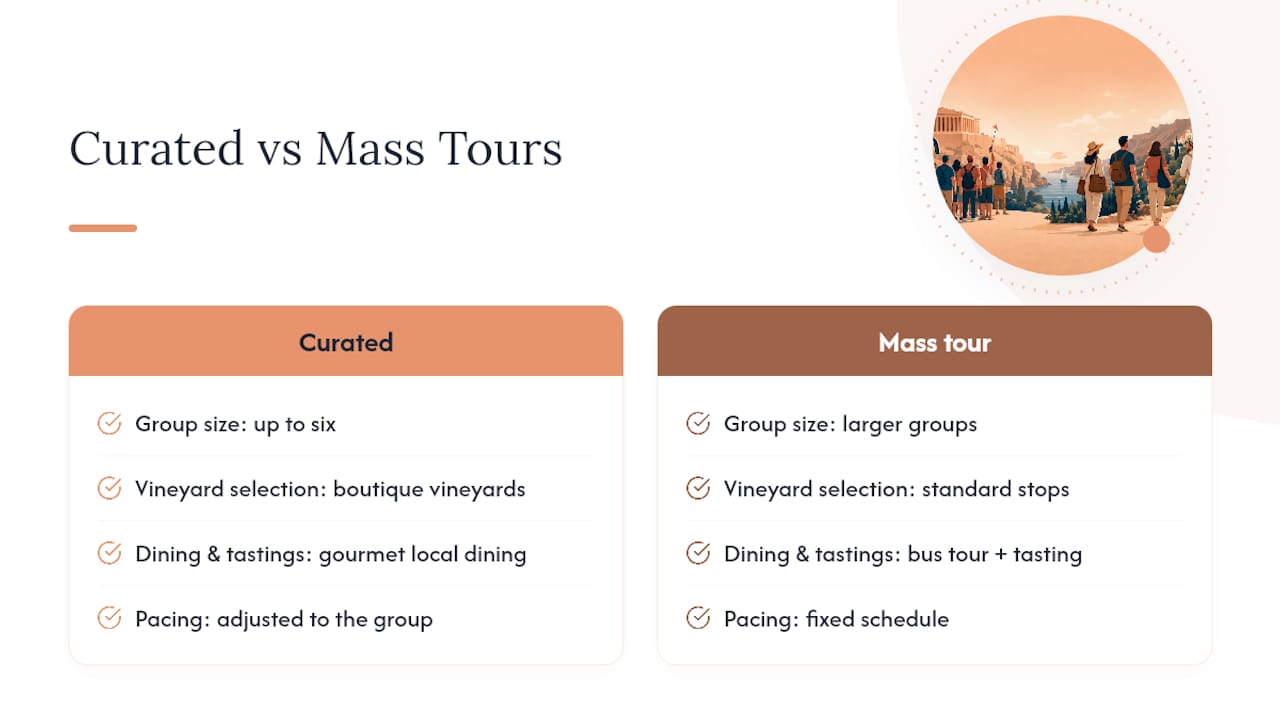
If everything above sounds like the kind of trip you’d actually want, the next step is simple. Theitalianonwaiheke keeps every tour to a small group of up to six, pairs boutique vineyard visits with gourmet local dining, and adjusts pacing around who’s actually in the group that day. Guests who want more than a bus tour with a tasting bolted on tend to notice the difference within the first hour. Providers who manage bookings, deposits, and group logistics often rely on dedicated systems like tour operator booking software to keep third-party reservations organized, which is part of why transparent inclusions matter so much when you’re evaluating a curator. You can see current availability and lock in a date directly through Theitalianonwaiheke’s booking page.
Frequently Asked Questions
What does curated itinerary mean in simple terms? It means a travel plan built specifically around your preferences and vetted first-hand by a curator, rather than a fixed schedule sold to every traveler.
Is a curated itinerary always more expensive than a standard tour? Not necessarily. Light customization can carry a modest fee, while fully bespoke planning with private access sits at premium pricing.
How far in advance should I book a curated itinerary? Plan for 30 to 90 days for most bespoke trips. Last-minute requests inside two weeks limit how much real customization is possible.
What’s the difference between a curated and a custom itinerary? The terms overlap heavily. Both describe plans built around individual preferences, though “curated” often implies stronger first-hand vetting of each recommendation.
Sources
Recommended
Comments